Quote: "The year was 2081, and everybody was finally equal. They weren't only equal before God and the law. They were equal every which way. Nobody was smarter than anybody else. Nobody was better looking than anybody else. Nobody was stronger or quicker than anybody else."
Dab
Here it is simply stated,"The year was 2081, and everybody was finally equal. They weren't only equal before God and the law. They were equal every which way."
Dollop
In order to prove that everyone was equal on levels, the narrator pointed out that ""everybody was finally equal. They weren't only equal before God and the law. They were equal every which way."
SAUCE!
Obviously, some people would need help believe and understanding that everyone was completely equal. In order to reassure this fact, it was said that "they weren't only equal before God and the law. They were equal every which way." making it very straightforward for the people who could not grasp the concept.
Tuesday, October 21, 2008

Monday, October 20, 2008
Sandwich. [yummmm]
Claim: Everyone was equal in every single way. Not one person stood out from one another.
Quote: "The year was 2081, and everybody was finally equal. They weren't only equal before God and the law. They were equal every which way. Nobody was smarter than anybody else. Nobody was better looking than anybody else. Nobody was stronger or quicker than anybody else."
Commentary: This quote tells us that everyone had lost specific traits that made them stand out from everyone else. They all had the same traits, the same brain capacity, and the same strength. In order to do this, some people had handicaps.
Claim: The handicaps were not successful on everyone.
Quote: "Harrison tore the straps of his handicap harness like wet tissue paper, tore straps guaranteed to support five thousand pounds.
Harrison's scrap-iron handicaps crashed to the floor.
Harrison thrust his thumbs under the bar of the padlock that secured his head harness. The bar snapped like celery. Harrison smashed his headphones and spectacles against the wall.
He flung away his rubber-ball nose, revealed a man that would have awed Thor, the god of thunder."
Commentary: This quote obviously tells us about how Harrison broke free from his handicaps. It seemed as if the handicaps did not affect him at all. Harrison was still able to think, use his eyes, and stand with all of his handicaps, all of which were supposed to be very strong and controlling.
Quote: "The year was 2081, and everybody was finally equal. They weren't only equal before God and the law. They were equal every which way. Nobody was smarter than anybody else. Nobody was better looking than anybody else. Nobody was stronger or quicker than anybody else."
Commentary: This quote tells us that everyone had lost specific traits that made them stand out from everyone else. They all had the same traits, the same brain capacity, and the same strength. In order to do this, some people had handicaps.
Claim: The handicaps were not successful on everyone.
Quote: "Harrison tore the straps of his handicap harness like wet tissue paper, tore straps guaranteed to support five thousand pounds.
Harrison's scrap-iron handicaps crashed to the floor.
Harrison thrust his thumbs under the bar of the padlock that secured his head harness. The bar snapped like celery. Harrison smashed his headphones and spectacles against the wall.
He flung away his rubber-ball nose, revealed a man that would have awed Thor, the god of thunder."
Commentary: This quote obviously tells us about how Harrison broke free from his handicaps. It seemed as if the handicaps did not affect him at all. Harrison was still able to think, use his eyes, and stand with all of his handicaps, all of which were supposed to be very strong and controlling.
Harry son.
What do we lose in an equal society?
- uniqueness
- expression
- memories
Harrison vs. Society
Exposition: Hazel and George are watching TV. They are handicapped. Harrison is in jail. Takes place in 2081.
Rising Action: Harrison breaks free. Harrison is on the TV. He declares that he is the Emperor and starts to dance with a ballerina. Diana walks in.
Climax: Harrison is shot.
Falling Action: The TV screen goes off. Hazel and George do not remember anything.
Resolution: Hazel says, "Boy, that was a doozy."
If not for equality, what should we strive for in our society?
I believe that we should strive for overall peace and tolerance.
Thursday, October 16, 2008
Notes 10/16/07
Handicaps
-masks
-radio transmitters
-sandbags/bindshot
-chains
-shave eyebrows
-red rubber nose
-speech impediment
-hardsire
-masks
-radio transmitters
-sandbags/bindshot
-chains
-shave eyebrows
-red rubber nose
-speech impediment
-hardsire
Wednesday, October 15, 2008
Book Report?!
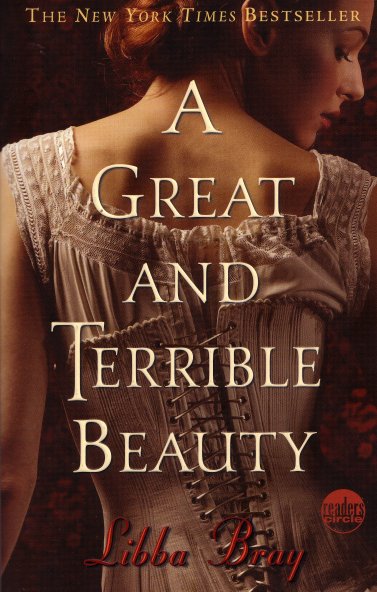
Book: A Great and Terrible Beauty
Author: Libba Bray
1. Did this book make you laugh? Cry? Smile? Cheer? Explode? Explain your reaction. A Great and Terrible Beauty definitely made me smile many times. Gemma, the main character, is going through the difficult challenges that young women have to endure in the early 1800's. Not only that, but she has a power that none of the girls at her finishing school possess. Gemma's mistakes are often humorous, which made me smile. She was also very witty and did many courageous things that made me laugh. For example, she and Kartik, a roaming gypsy, had many quarrels that left me smiling because of their odd humor.
2. What was the author saying about life and living in this book? Libba Bray, I believe, was trying to tell young women about how many more options they have now than the women of the past. She tells us that just because women were looked upon to be prim and proper, not everyone followed the chosen path. Gemma did not follow the rules very well, and talked to Kartik, which is forbidden because it is not proper for young ladies to talk with uneducated and filthy “savages”. Gemma was one of the strongest women in the world, with her special power to enter into another realm, but she chose to keep it a secret, fearing the jealousy and corruption that would occur in The Realm. This was a message that women had power in the Victorian times, but it was not typical.
3. Do you believe the title fits the book? Why or why not? I do believe that the title fits the book. Gemma's power to enter The Realm freely was a gift to her. A group called the Order used to rule The Realms, but the power was bound when the group became corrupt. Gemma's mother belonged to the Order, and the magic flowed down to Gemma who was the only person allowed to roam freely in the Realms. Gemma also received frightening visions because of her magic. This was a great thing because she could see the future and prevent bad things to occur, but it was also terrible because sometimes she caused the bad things to happen while trying to prevent it. The magic was a gift when dancing freely in the Realms, but a curse when having to deal with repercussions in the normal world.
4. What do you feel is the most important word, sentence, or passage in the book? The most important event, character, feeling, or decision? Why is it important? “But forgiveness...I'll hold onto that fragile slice of hope and keep it close, remembering that in each of us lie good and bad, light and dark, art and pain, choice and regret, cruelty and sacrifice.” I believe this passage is important because it shows that there is not perfection in any society. Gemma made bad decisions, and sacrificed other peoples' integrities in order to be blameless. This passage tells of how we all have flaws and strengths, and that we must remember to forgive each other for our mistakes. Gemma is learning how to forgive herself, and hoping that others will forgive her as well.
5. Do any of the character remind you of friends, family members, or classmates? Explain.
Felicity Worthington actually reminds me of my friend, Eva. She is described as having light blond hair and cool gray eyes. Not only that, but in some ways they act similarly. Eva and Felicity both just want to have fun. Felicity is very cruel and that is what differs in mind between Eva and Felicity. Ashley Stein and Ann Bradshaw also have similarities. Both are very shy and timid, but are loud when with friends. Ann is much more pathetic than Ashley though, and Ashley would stand up for herself where Ann Bradshaw does not. My brother reminds me of Thomas Doyle, because they both are close with their sisters, but do not share any personal information that they are not comfortable with. Both are very playful and like to tease their sisters.
Monday, October 13, 2008
CONFLICT!
person vs. self: Tom's realization that he wasted his life
person vs. self: Tom froze up and panicked on the ledge, although he knew that he had to keep moving.
person vs. nature: Tom Benecke vs. wind [the wind blew his paper out of the window]
person vs. nature/environment: Tom had to break the window or stay out on the ledge.
Exposition: Tom Benecke lives in an apartment in New York City with his wife, Clare. He works very hard to rise in his company and writes all of his research and observations on a piece of yellow paper.
Rising Action: The wind blew the paper out of the window. Tom climbed out of the window to retrieve the paper. Tom tries to reach for the paper and almost falls because he looked down and saw how far above the ground he was. He realizes that he has been wasting his life and keeps scaling the building. He drops several objects, trying to catch someone's attention to no avail.
Climax: Tom breaks the window, putting his life on the line, because if the window does not break, he will fall backwards, off of the ledge.
Declining Action: Tom gets back into the apartment and returns his paper to his desk, putting a pencil on top of it as a weight.
Resolution: The paper blows out of the window and Tom laughs, walking out the door.
person vs. self: Tom froze up and panicked on the ledge, although he knew that he had to keep moving.
person vs. nature: Tom Benecke vs. wind [the wind blew his paper out of the window]
person vs. nature/environment: Tom had to break the window or stay out on the ledge.
Exposition: Tom Benecke lives in an apartment in New York City with his wife, Clare. He works very hard to rise in his company and writes all of his research and observations on a piece of yellow paper.
Rising Action: The wind blew the paper out of the window. Tom climbed out of the window to retrieve the paper. Tom tries to reach for the paper and almost falls because he looked down and saw how far above the ground he was. He realizes that he has been wasting his life and keeps scaling the building. He drops several objects, trying to catch someone's attention to no avail.
Climax: Tom breaks the window, putting his life on the line, because if the window does not break, he will fall backwards, off of the ledge.
Declining Action: Tom gets back into the apartment and returns his paper to his desk, putting a pencil on top of it as a weight.
Resolution: The paper blows out of the window and Tom laughs, walking out the door.
Wednesday, October 8, 2008
&&Contents of a Dead Man's Pocket
Title: Contents of a Dead Man's Pockets
Author: Jack Finney
Date Read: October 8, 2008
Author: Jack Finney
Date Read: October 8, 2008
Pre-reading: 5 Top Priorities in My Life
- Family
- Schoolwork
- Friends
- Practice
- Personal Happiness/Free Time
Plot: Tom Benecke is very hardworking man, trying to gain status in the company he works for. As a result of this, Tom starts a project in order to prove the effectiveness of a display that he would create for the company. He recorded a lot of information on a certain piece of paper that took many months to out together. One night, when his wife goes out to see a movie, he stays in to continue his work on the project. Unfortunately, the paper that he had been working on flew out the window and was stuck on a ledge outside. There was nothing he could do to get his paper, except climb out on the ledge and retrieve it. As he is on the ledge, he sees how far above the ground he is and he panics. His legs start to shake and it is hard for him to stay on the ledge. While he is up there, he realizes that he has been working so hard and ignoring his family; he has accomplished nothing. After debating with himself, he moves toward the window of his apartment. When he reaches the window, he bumped it and it shut, making it impossible to open without falling. He tries several ways to catch peoples' attention, but all fail. Finally he punches the window, breaking the glass, and goes inside to place his paper down on the desk with a pencil on top, using it as a weight. The pencil fell off the paper, the paper flew out the window, and he laughed.
Questions:
- What if we work so hard towards something, such as a goal, only to never succeed? Will our life be worthless because we cannot reach our expectations? Will our work be for nothing?
- Why would Tom work for months writing all of his information, but only have one piece of paper to show for it? Wouldn't he have many sheets because he had been working so extensively on his project?
Significant Quotes:
"Contents of a dead man's pockets, he thought with sudden fierce anger, a wasted life."
"As he saw the yellow paper, the pencil flying, scooped off the desk and, unimpeded by the glassless window, sail out into the night and out of his life, Tom Benecke burst into laughter and then closed the door behind him."
Subscribe to:
Posts (Atom)
